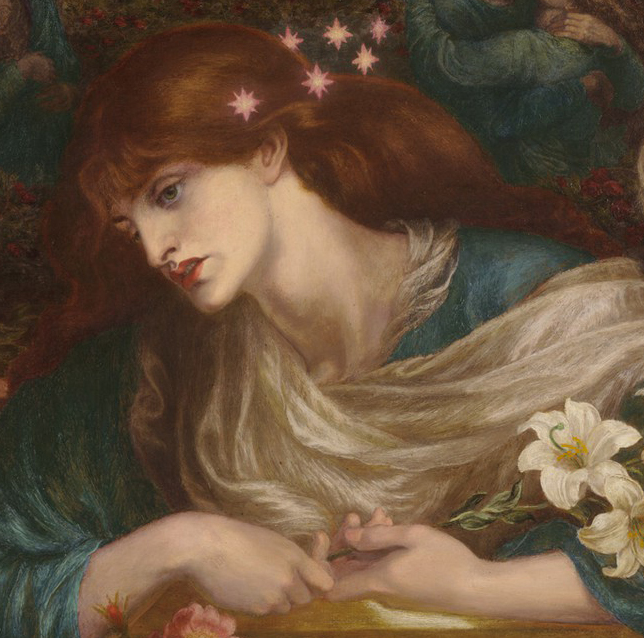
The name reflects admiration for art created before Raphael, which the artists of the PRB believed was more sincere and spiritually rich.
The Pre-Raphaelite movement was a 19th-century group of British artists and writers who rejected the academic style of the time, aiming to return to the rich detail, vibrant color, and spiritual sincerity of art before Raphael. They often depicted medieval, literary, and nature-inspired themes with romantic and realistic elements.
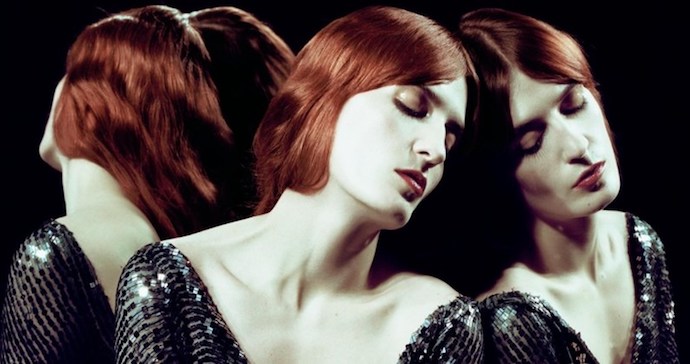
Women are at the heart of Pre-Raphaelite art, giving rise to the enduring idea of the ‘Pre-Raphaelite Woman.’ The term often appears in media today to describe actresses or musicians with long, flowing hair. Musician Florence Welch being a frequent example and proud embodiment of the look.
But was there ever a single ideal? When we look beyond the painted canvases to the real women who inspired them, we find a rich diversity. To their credit, the Pre-Raphaelites and their circle didn’t idealize just one type. Women of varying shapes, features, and presence became muses. Over time, their individual strengths have blended into the image we now call the ‘Pre-Raphaelite Stunner.’
While I’m wary of reducing any woman to her appearance alone, exploring how these models helped shape a visual legacy can offer meaningful insight into the aesthetic we associate with ‘Pre-Raphaelite.’
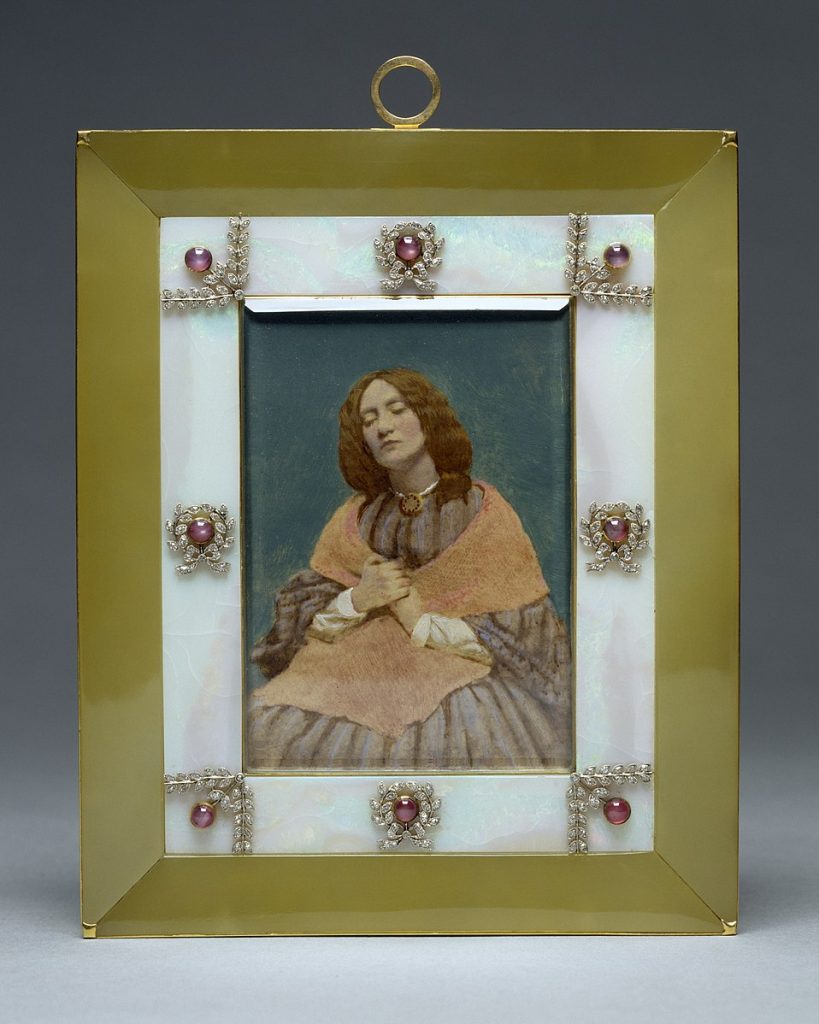
Photograph of Elizabeth Siddal
Elizabeth Siddal
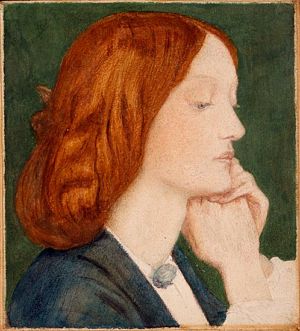
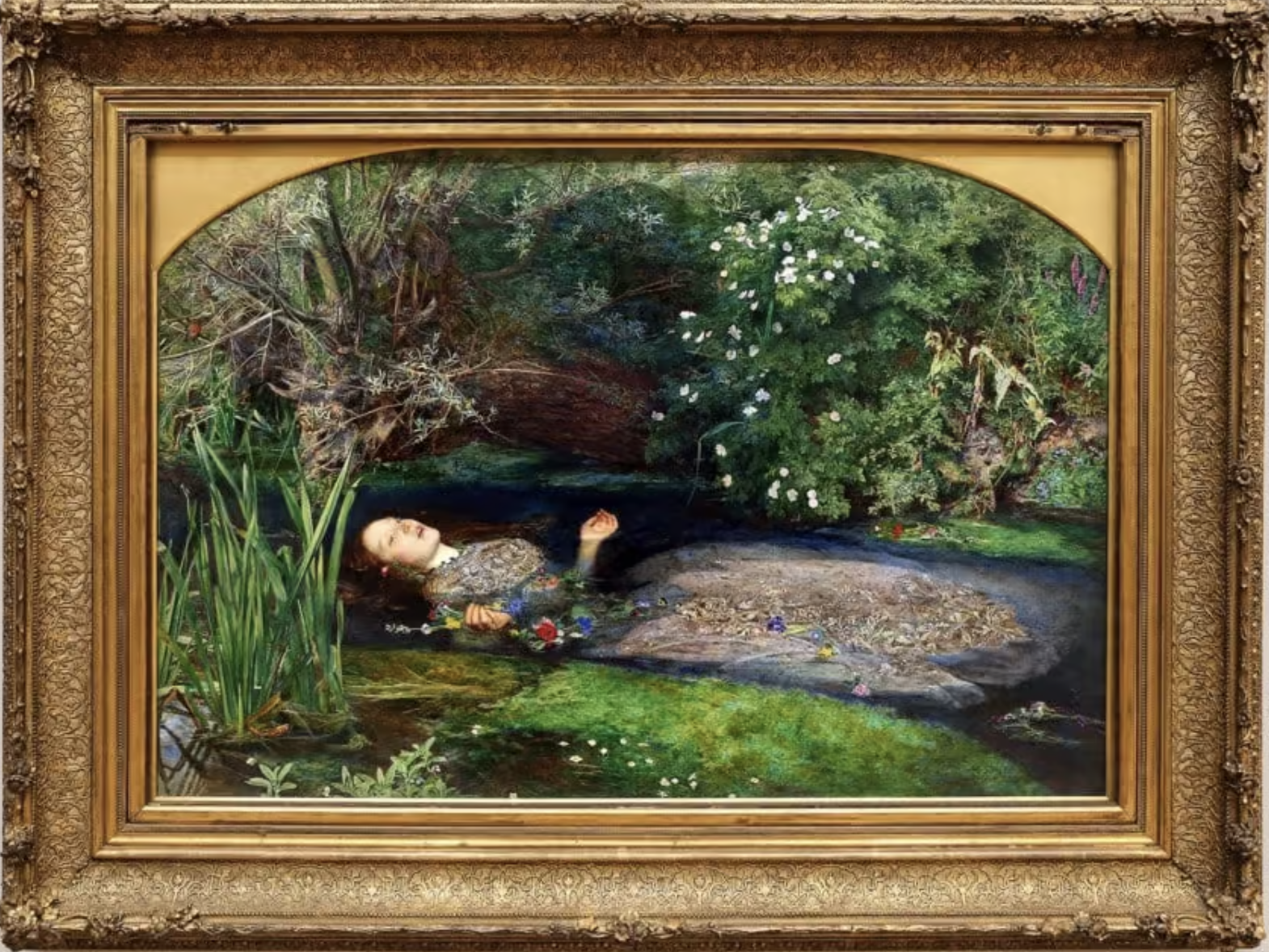
Elizabeth Siddal was one of the earliest and most iconic Pre-Raphaelite models. Discovered while working at Mrs. Tozer’s millinery shop, she made her first appearance in Walter Howell Deverell’s painting Twelfth Night. Soon after, she posed for William Holman Hunt and John Everett Millais, most famously as Ophelia. Eventually, Siddal became the exclusive muse of Dante Gabriel Rossetti. The artist also took her on as a pupil as she began a promising artistic career of her own. Their passionate, on-again-off-again relationship spanned nearly a decade before they finally married in 1860.
Siddal’s life, however, was marked by physical and emotional suffering. Often described as fragile, she became addicted to laudanum, an opiate commonly used at the time. The stillbirth of her daughter deepened her depression, and in 1862, Siddal died of an overdose.
Seven years later, in artistic desperation, Rossetti had her grave exhumed to retrieve a manuscript of poems buried with her. That act cast a lasting shadow of tragedy and macabre fascination over Siddal’s legacy.
Yet at the beginning, it was her face and presence that deeply inspired Rossetti. His sister, poet Christina Rossetti, captured this devotion in her poem In an Artist’s Studio. As one line puts it: ‘He feeds upon her face by day and night.’
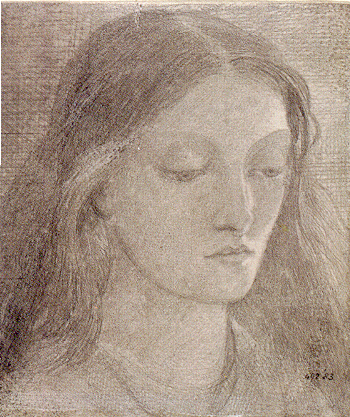
Ford Madox Brown dubbed Rossetti’s drawings of Siddal a “monomania,” and Rossetti himself wrote that seeing her defined his destiny. Her features soon dominated his art throughout the 1850s, shaping the Pre-Raphaelite ideal.
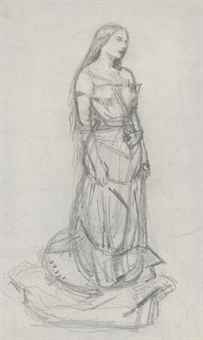
Drawing of Elizabeth Siddal by Dante Gabriel RossettiSketch of Elizabeth Siddal, Dante Gabriel Rossetti
Elizabeth Siddal did not fit the mold of conventional Victorian beauty. At a time when a petite, delicate frame was idealized, she was considered somewhat tall. Red hair, too, was unfashionable and was often seen as a sign of bad luck or unattractiveness. Yet Siddal’s vivid hair became a hallmark of Pre-Raphaelite art. Rossetti and his peers portrayed her flowing red locks with such romantic intensity that they helped redefine its aesthetic appeal.
In the years after her death, Siddal’s hair took on an almost mythical status. Charles Augustus Howell claimed that when she was exhumed, her hair had continued to grow. filling the casket with fiery strands. Though biologically impossible, the story endured, becoming part of the eerie and enduring legend that surrounds the Pre-Raphaelite circle.
Portrait of Elizabeth Siddal (1854), Dante Gabriel Rossetti.
While Rossetti was captivated by Elizabeth Siddal’s features, it’s equally compelling to consider how Siddal saw herself.
Her self portrait reflects the Pre-Raphaelite commitment to truth in nature. It stands apart from the idealized images of women often associated with the movement. Siddal presents herself with honesty and directness, an unflinching portrayal that resists romanticization.
Self Portrait of Elizabeth Siddal
Annie Miller
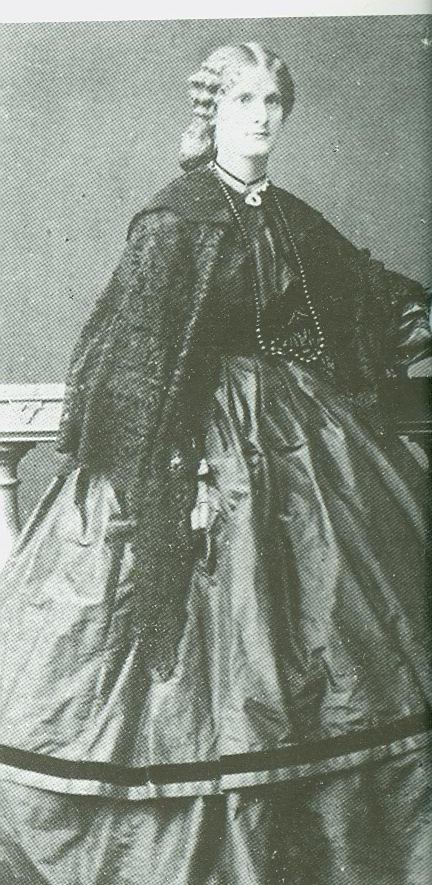
Annie Miller was a muse to artist William Holman Hunt and appeared in some of the earliest Pre-Raphaelite works. Hunt intended to marry her and arranged for her to receive lessons in refinement, hoping to elevate her social standing. Their relationship became strained, especially during his extended trip to the Middle East, and the marriage never happened.
Frustrated by what he saw as her inappropriate behavior, Hunt later erased Miller’s likeness from many paintings, including The Awakening Conscience and Il Dolce Far Niente. As a result, Rossetti’s portrayals are what keep her presence in the Pre-Raphaelite story alive; the images I’ll share below..
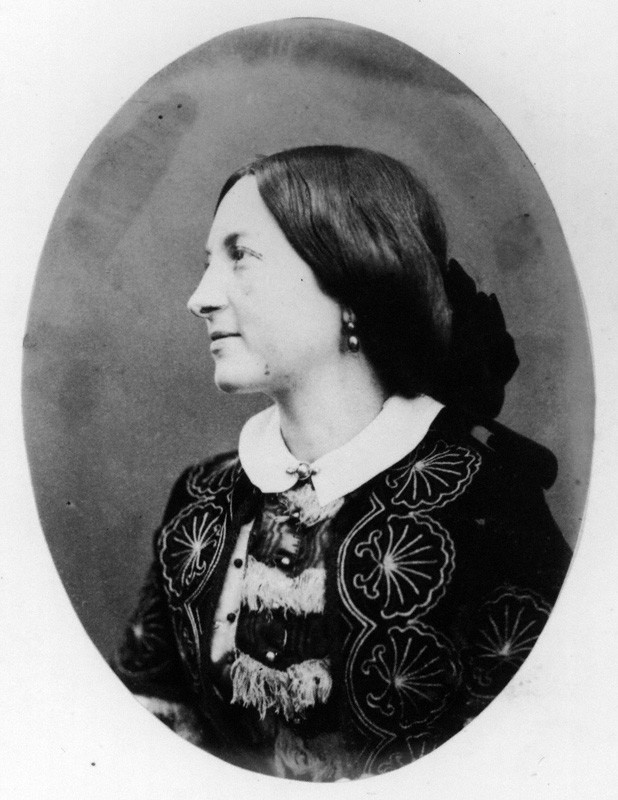
Drawing of Annie Miller by Dante Gabriel RossettiAnnie Miller as Helen of Troy, Dante Gabriel RossettiAnnie Miller in Dante Gabriel Rossetti’s painting ‘Woman in Yellow’Photograph of Annie Miller
Effie Millais
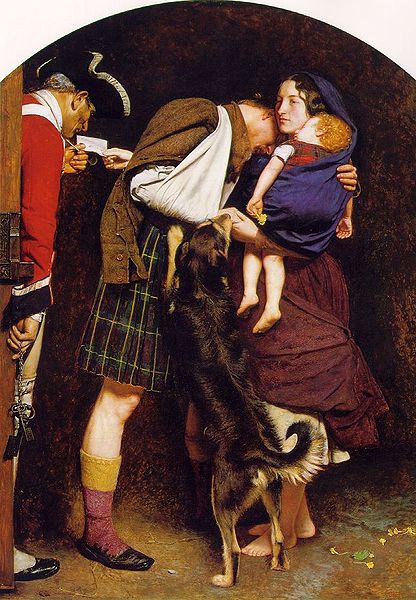
Effie Gray was trapped in a cold, unconsummated marriage to critic John Ruskin when she met John Everett Millais. After a painful annulment, requiring her to prove her virginity, she and Millais were finally free to marry.
Emma Thompson wrote and starred in a film about Effie’s story, with Dakota Fanning playing Effie Gray.
The Order of Release, Sir John Everett MillaisStudy of Effie Millais for ‘The Eve of St. Agnes’Photograph of Effie Millais by (George) Herbert Watkins, albumen print, late 1850s
Fanny Cornforth
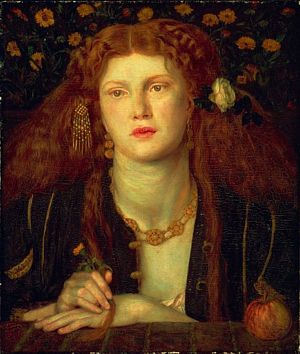
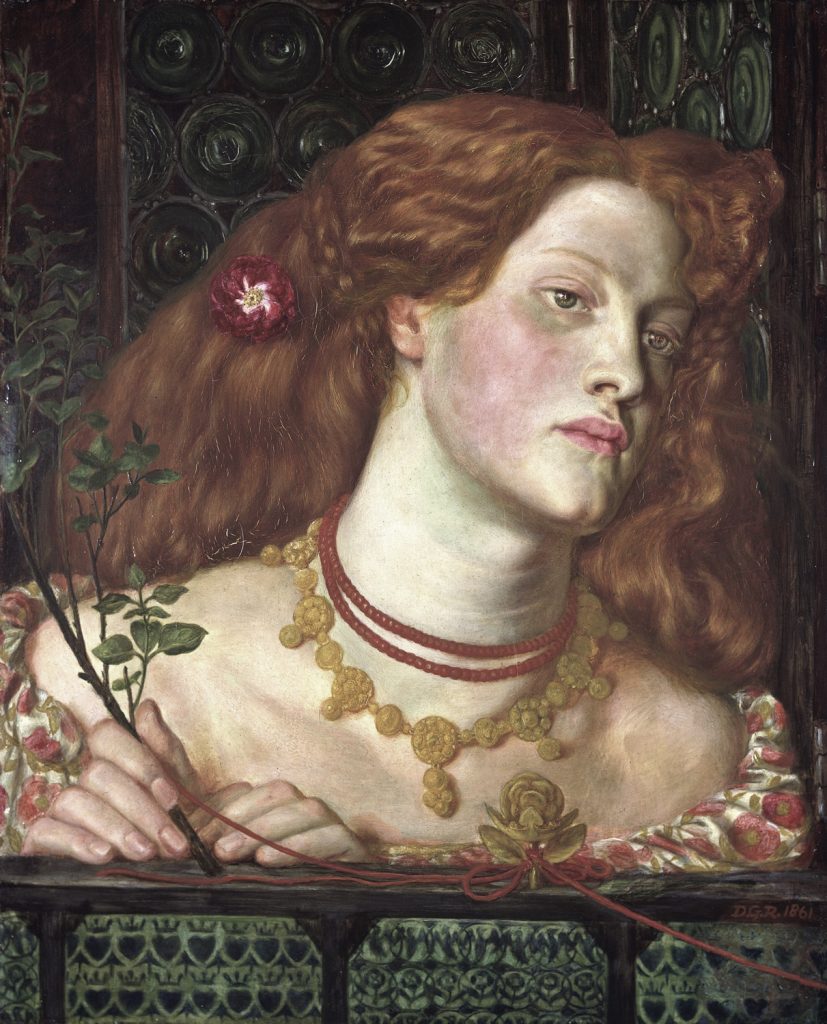
Fanny Cornforth may have been Rossetti’s truest and most loyal companion. Often dismissed or disparaged by those in his inner circle, she nonetheless remained steadfast. Her arrival ushering in a new, sensuous phase of his work, most notably with Bocca Baciata (The Kissed Mouth).
In contrast to Elizabeth Siddal’s frequent illnesses, Cornforth was vibrant, full-figured, and full of life. Yet despite her closeness to Rossetti, she was not the woman he would marry.
Over time, her role shifted from muse to housekeeper as Rossetti’s artistic focus turned to other faces. Still, she remained a constant presence in his life, a living reminder of an era of joy and creative freedom. I highly recommend reading Stunner: The Fall and Rise of Fanny Cornforth by Kirsty Stonell Walker.
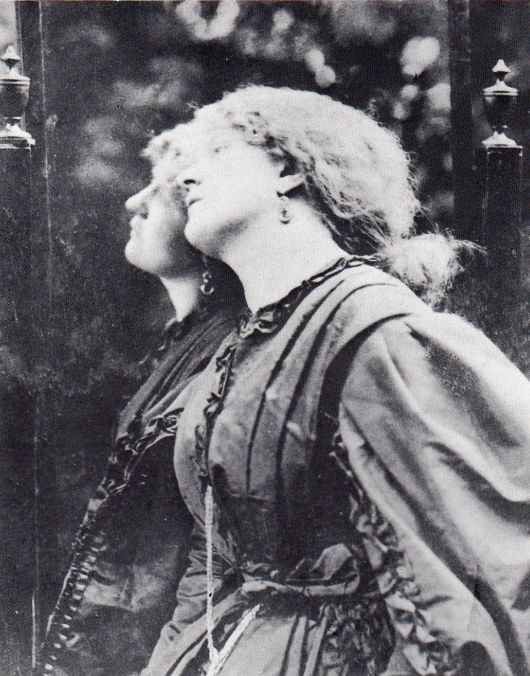
Fanny in Fazio’s Misstress, Dante Gabriel RossettiBocca Baciata, Dante Gabriel RossettiPhoto of Fanny CornforthFair Rosamund, Dante Gabriel Rossetti
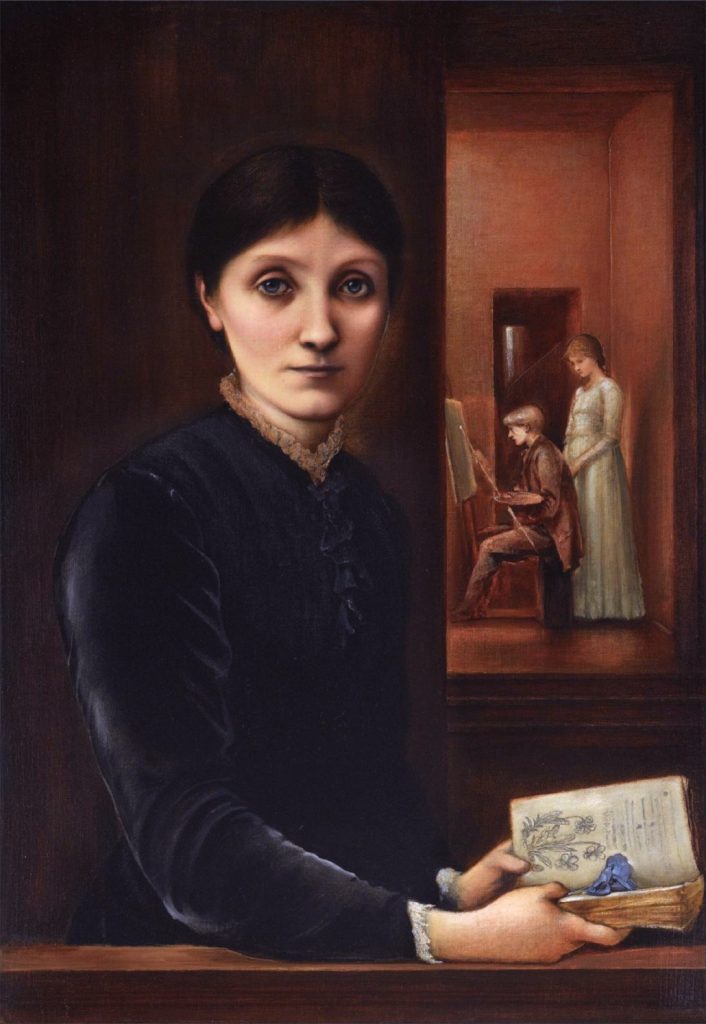
Georgiana Burne-Jones
Georgiana Burne-Jones became engaged to Edward Burne-Jones, whom she lovingly called ‘Ned,’ while still in her teens. Known for her gentle nature and devotion, she remained a supportive partner throughout his life and career.
Known as “Georgie,” she was the fifth of eleven MacDonald children. Her sister Agnes married painter Edward Poynter, while Louisa became Stanley Baldwin’s mother and Alice gave birth to Rudyard Kipling.
Photograph of Georgiana Burne-JonesGeorgiana Burne-Jones, painted by Sir Edward Burne-JonesGeorgiana Burne-Jones, their children Margaret and Philip in the background,
Maria Zambaco
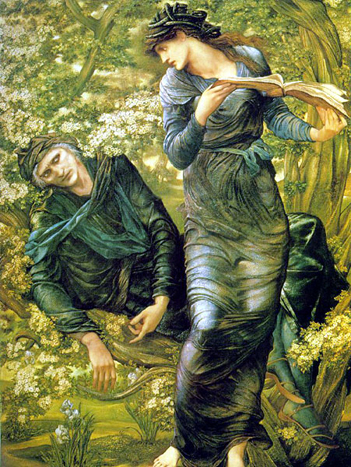
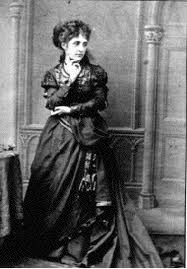
Despite his devoted marriage to Georgiana, Burne-Jones had a major affair with Maria Zambaco. As things turned turbulent, his depictions of her took on deeper, conflicted tones.
Maria Zambaco in ‘Cupid and Psyche’ by Sir Edward Burne-Jones‘The Beguiling of Merlin, Sir Edward Burne-JonesPhotograph of Maria Zambaco
Jane Morris
Jane Morris entered the Pre-Raphaelite circle in Oxford, catching the attention of Rossetti and Burne-Jones during a theater performance.
She married William Morris, Rossetti’s close friend, yet later began a passionate relationship with Rossetti. Their story endures, made all the more striking by Morris’s unwavering support of her, despite his pain.
Rossetti’s paintings of Jane took on the same obsessive quality that characterized his earlier works with Elizabeth Siddal. Once again, the artist’s fixation is channeled through the image of his muse.
Jane Morris in ‘The Salutation of Beatrice’, painted by Dante Gabriel RossettiProserpine, Dante Gabriel RossettiThe Day Dream, Dante Gabriel Rossetti
Alexa Wilding
Rossetti noticed Alexa Wilding on a bustling street and promptly asked her to model for him. Tall and strikingly different from his muse Jane Morris, Alexa’s physical features were a distinct contrast.
Kirsty Stonell Walker has crafted a captivating fictionalized account of Alexa’s life in A Curl of Copper and Pearl. It’s a fascinating a glimpse into the world of this enigmatic muse..
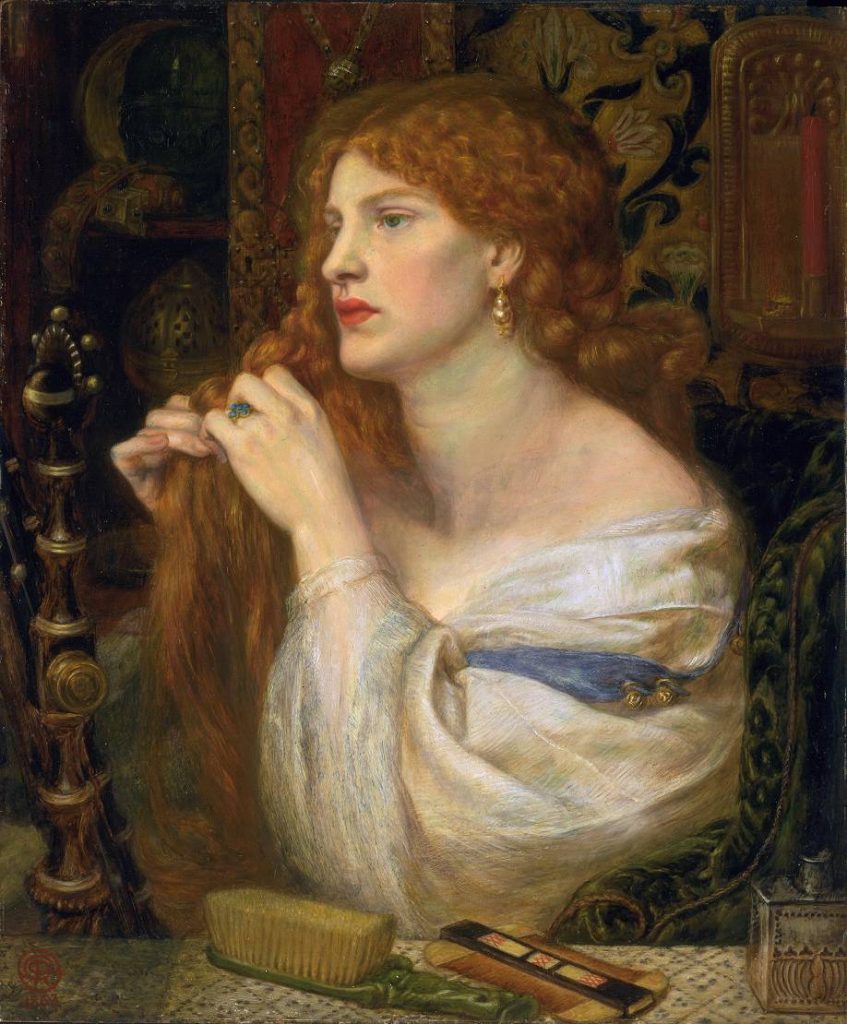
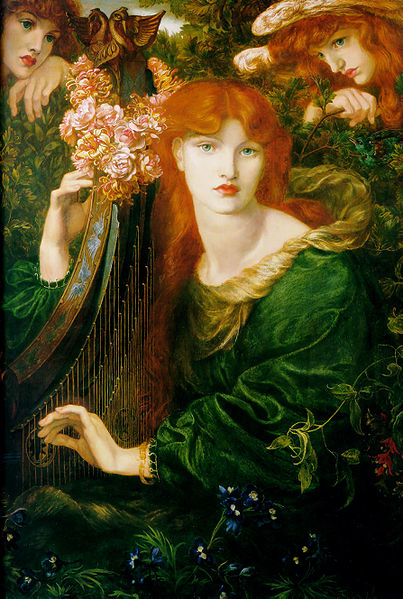
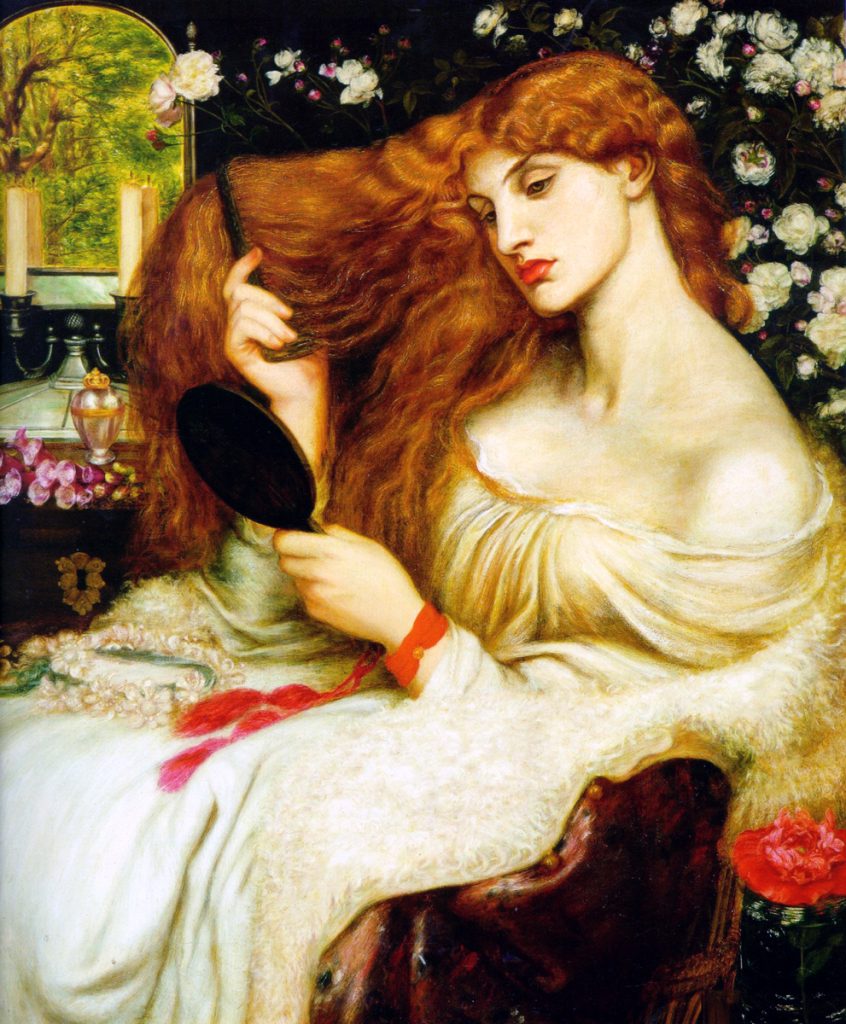
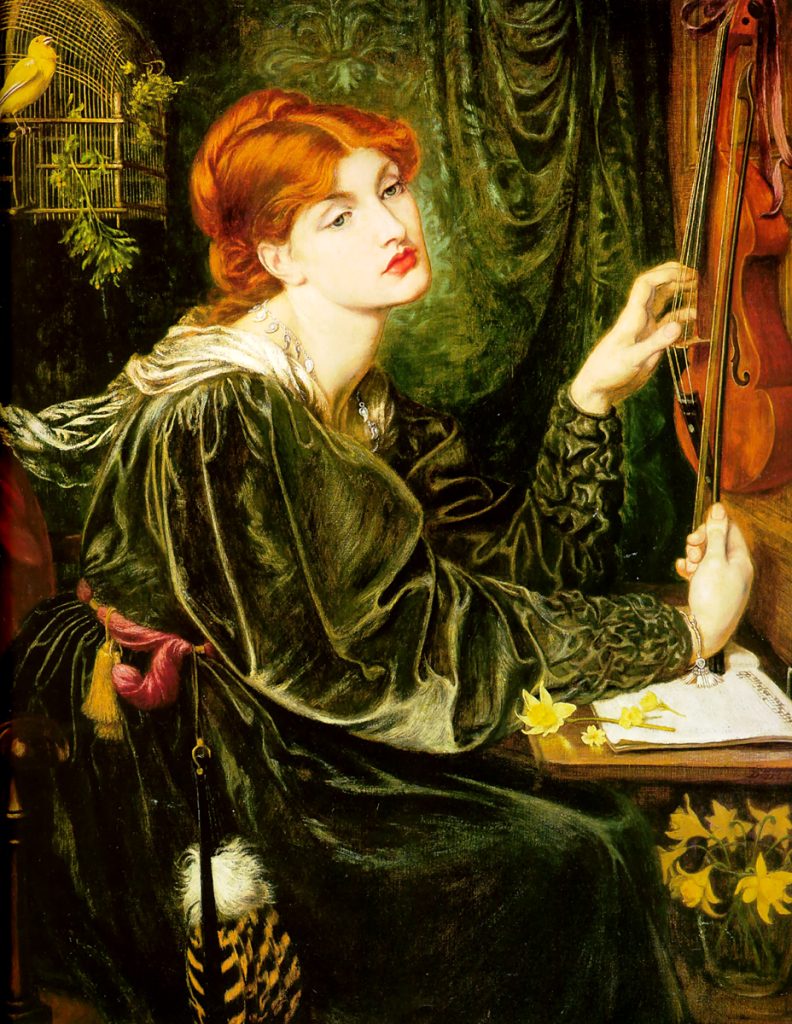
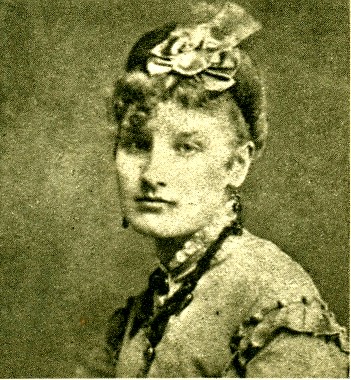
Alexa Wilding in Dante Gabriel Rossetti’s ‘La Ghirlandata’Alexa Wilding, ‘Lady Lilith’, Dante Gabriel Rossetti‘Veronica Veronese’. Dante Gabriel RossettiPhotograph of Alexa Wilding
What about Pre-Raphaelite beauty in today’s woman?
It may seem like I’m pitting these women against one another by their looks, but that’s not my aim. I want to show that our idea of Pre-Raphaelite beauty is really an amalgamation.
The varied tastes of the Pre-Raphaelites combined to create the bold, beautiful look we now associate with the Pre-Raphaelites.
It’s an inspiring notion: the Pre-Raphaelite ideal grew from many women, and so does the world. In that sense, we’re all Stunners.
Break free from society’s limited standards of beauty. Embrace your unique strengths and quiet the inner critic that tries to hold you back. Together, we can celebrate the diverse beauty that makes up our world.
Pre-Raphaelite art is known for its exquisite luminosity, but how was this effect achieved? Why was it so radical at the time?
The Status Quo
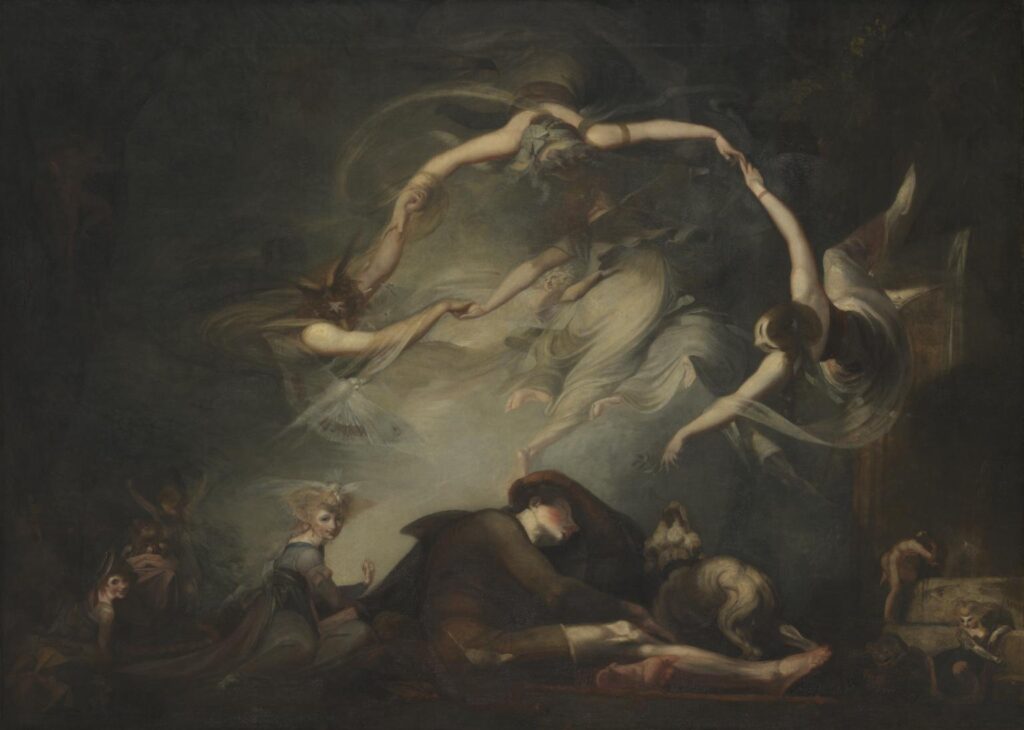
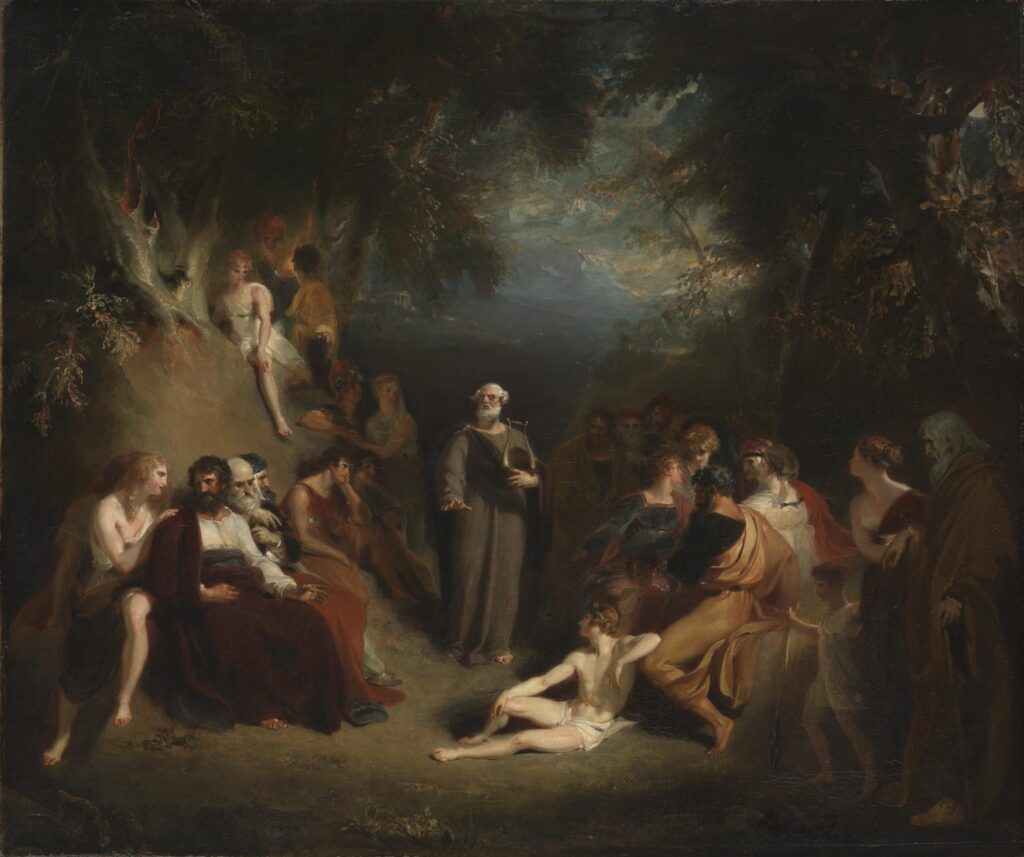
In the early nineteenth century, the majority of work produced by British artists consisted of darkly colored paintings, partly because of their reverence for seventeenth century masterpieces, but also due to the frequent use of bitumen, a tarry additive that creates a blackening effect, and further darkens over time.
The Shepherd’s Dream, from ‘Paradise Lost’, Henry Fuseli (1793) Homer Reciting his Poems, Sir Thomas Lawrence (1790)
Both paintings are classic and compelling works, but it’s easy to see why the Pre-Raphaelites were so driven to create art that practically bursts with brightness. When all the art surrounding you feels somber, how could you not long to create art with vibrant and intense pigments?
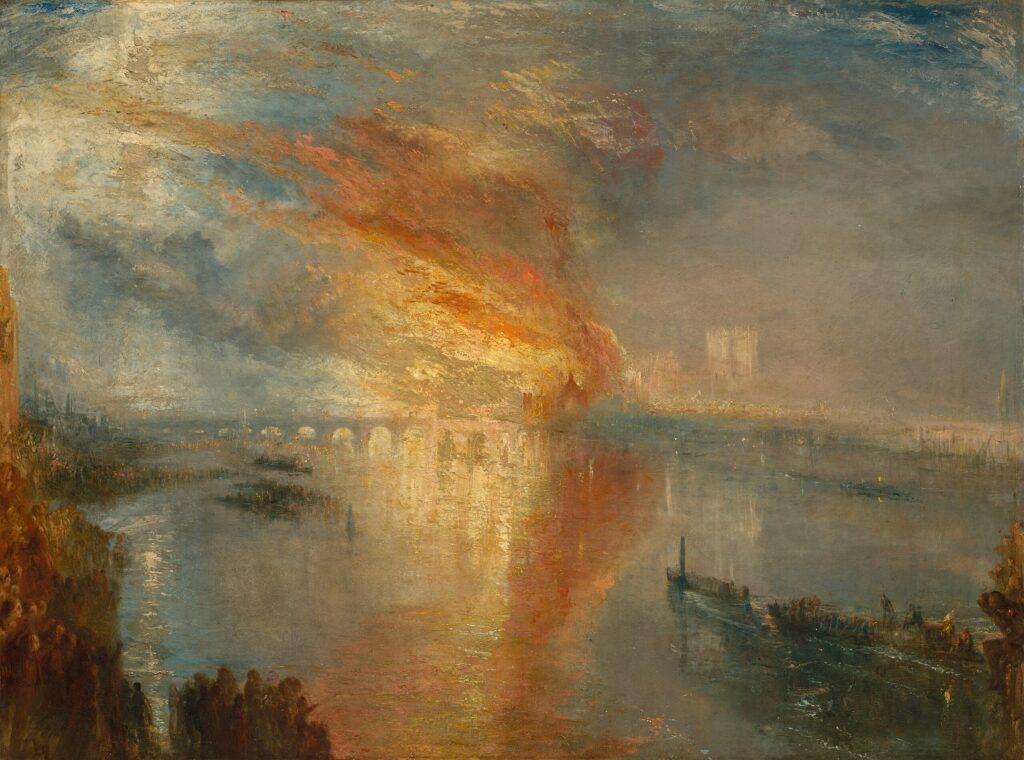
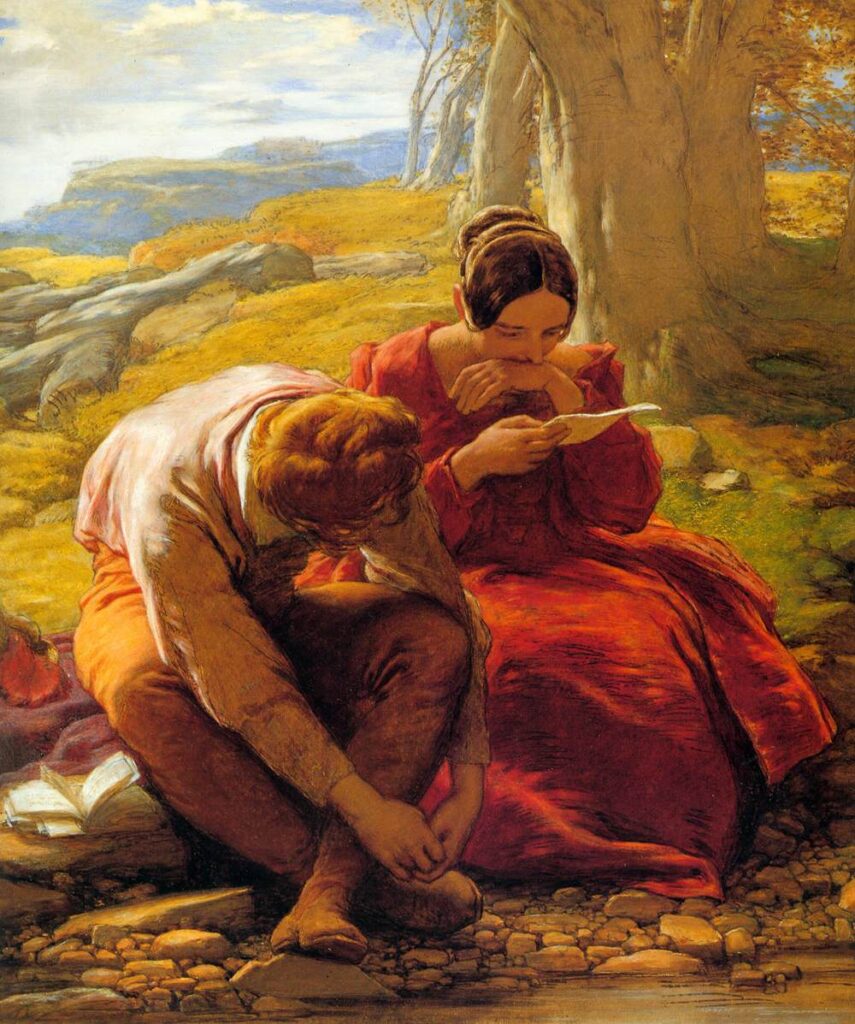
The Pre-Raphaelites were not the first nineteenth century artists to embrace a lighter tone. J.M.W. Turner displayed an impressive use of glowing light in his later works, and artist William Mulready was painting his works over a thin white ground two decades before the Pre-Raphaelite Brotherhood formed in 1848.
The Burning of the House of Lords and Commons, J.M.W. Turner (1834)The Sonnet, William Mulready (1839)
Despite occasional forays into expressions of light and color by artists like Turner and Mulready, earthy tones remained the norm, as did the belief that a painting should adhere to the Royal Academy’s unwritten edict: one area of principal light, with everything surrounding it swathed in some degree of shadow.
Enter the Brotherhood
The art world resembled a morose cauldron of bitumen to the seven young upstarts that formed the Pre-Raphaelite Brotherhood. They were champing at the bit to inject effervescent light and color onto the scene.
When the brotherhood formed, they were committed to embracing colors and techniques seen in works before the artist Raphael (1483-1520), as well as depicting nature in its true form.
The results were nothing short of revolutionary.
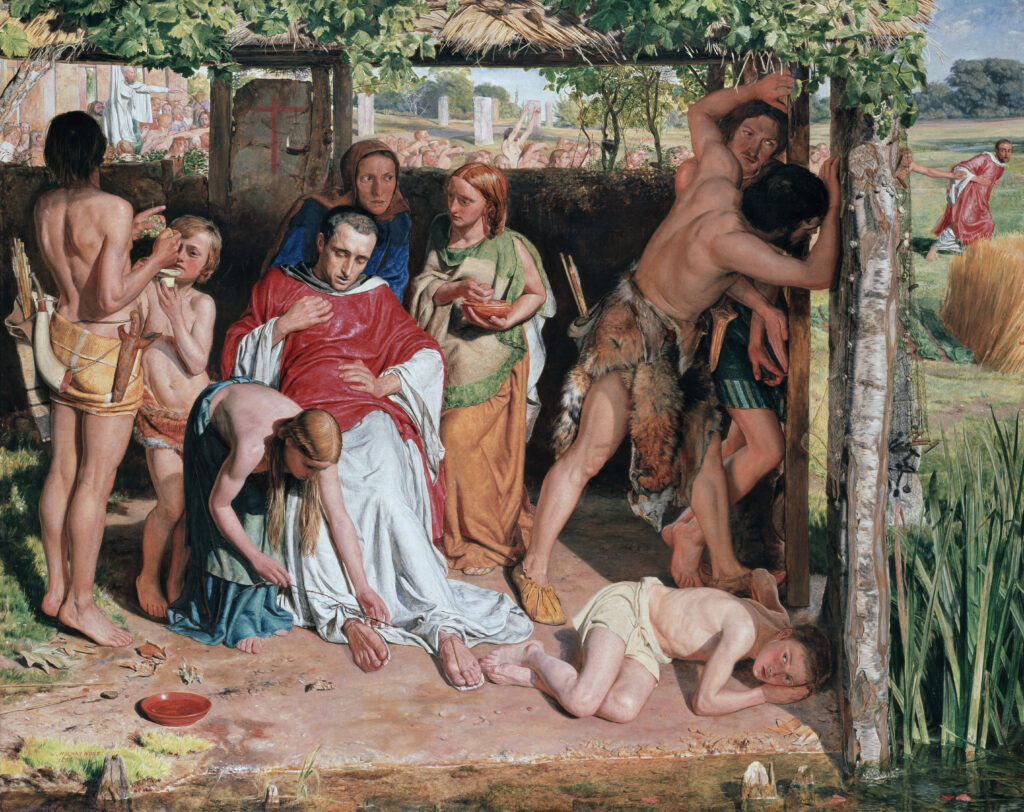
Despite its unwieldy title, A Converted British Family Sheltering a Christian Missionary from the Persecution of the Druids by William Holman Hunt is breathtakingly vivid in light, color, and detail (especially when viewed in conjunction with the darker-toned works that that had long been the status quo.)
A converted British Family sheltering a Christian Missionary from the Persecution of the Druids
*oil on canvas
*111 x 141 cm
*signed b.l.: W. HOLMAN HUNT 1850
How Did They Do It?
In his memoir, Pre-Raphaelitism and the Pre-Raphaelite Brotherhood, William Holman Hunt described the process he and his Pre-Raphaelite brethren used to obtain their startling luminosity. This entailed a wet, white ground and is quite complex in comparison to the thin white ground used previously by artist William Mulready.
“The process may be described thus. Select a prepared ground originally for its brightness, and renovate it, if necessary, with fresh white when first it comes into the studio, white to be mixed with a very little amber or copal varnish. Let this last coat become of thoroughly stone-like hardness. Upon this surface, complete with exactness the outline in part in hand. On the morning for the painting, with fresh white (from which all superfluous oil has been extracted by means of absorbent paper, and to which again a small drop of varnish has been added) spread a further coat very evenly with a palette knife over the part for the day’s work, of such consistency that the drawing should faintly show through. In some cases the thickened white may be applied to the forms needing brilliancy with a brush, by the aid of rectified spirits. Over this wet ground, the color (transparent and semi-transparent) should be laid with light sable brushes, and the touches must be made so tenderly that the ground below shall not be worked up, yet so far enticed blend with the superimposed tints as to correct the qualities of thinness and staininess, which over a dry ground transparent colors used would inevitably exhibit. Painting of this kind cannot be retouched except with an entire loss of luminosity.” William Holman Hunt, Pre-Raphaelitism and the Pre-Raphaelite Brotherhood
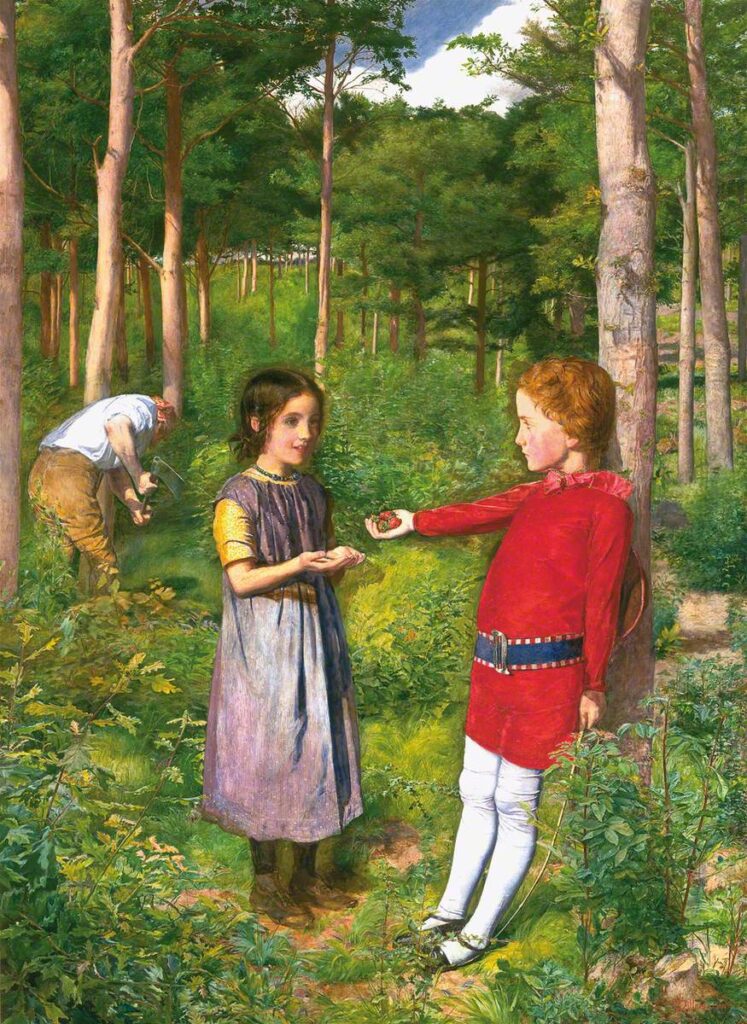
Millais, John Everett; The Woodman’s Daughter; City of London Corporation; http://www.artuk.org/artworks/the-woodmans-daughter-51226
The Brotherhood’s innovative new white base provided a reflective background, creating not only intense color, but brilliant illumination.
Many critics found the radical new sense of balance in the PRB’s work jarring. It was shocking for a painting not to have at least some area of the piece cloaked in shadow.
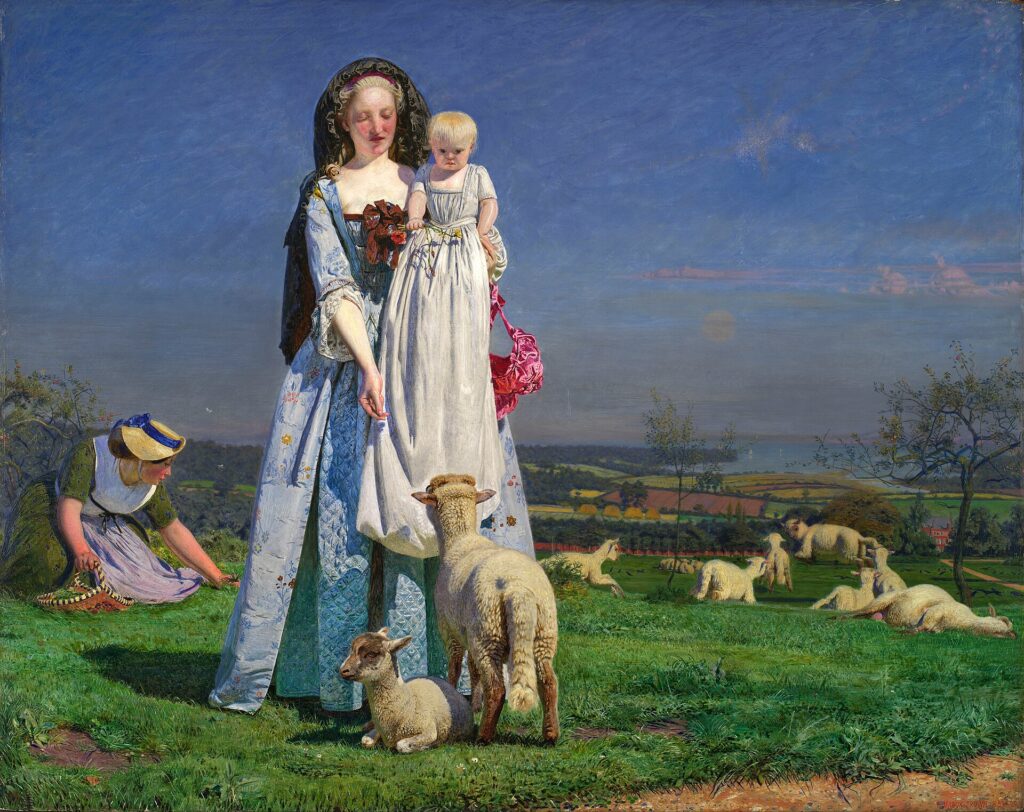
Pre-Raphaelite artists also considered a painting’s background as important as the foreground, sparing no attention to detail. Both of these factors produced a sense of hyperrealism that the British public had never seen before.
The Pretty Baa-Lambs, Ford Madox Brown (1851)
An Inspiration for Their Innovation?
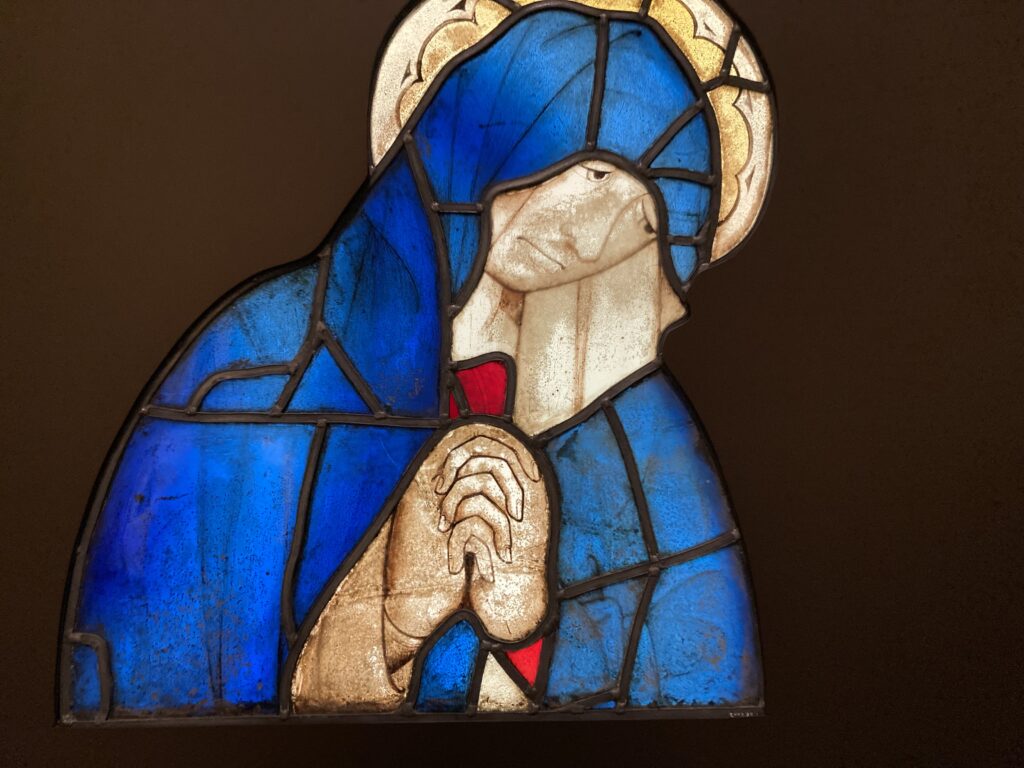
During a recent visit to the Getty Museum in Los Angeles, one room in particular completely captivated me: their collection of 14th and 15th-century stained glass.
It’s a dimly lit room, of course, so that these gorgeous antiquities can be shown to perfection, and the lighting creates a sacred feeling of awe. The windows are backlit so that they can be experienced as originally intended.
My first feelings were reverent, mindful of the fact that these windows carry a wealth of significance and originally adorned places of worship where the majority of the congregation could not read. A large part of the congregants’ knowledge of scripture came from what was read to them and what they saw in art like this – the windows that surrounded them, enveloping them with jeweled light and stunning, inspiring images.
The mere notion of the untold number of prayers that have been uttered in the presence of these windows touched my heart.
My second thoughts were of the Pre-Raphaelites. Inspired by the exquisite backlit presentation of each stained glass, a fresh notion occurred to me and I was able to think of the Pre-Raphaelite painting process in a deeper way.
For example…
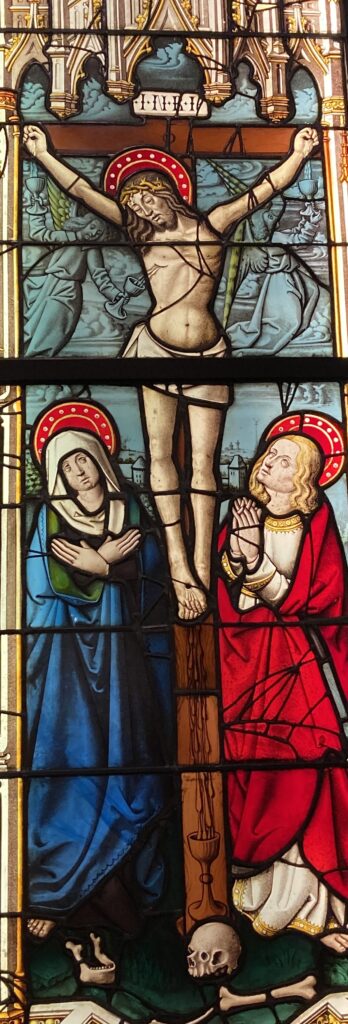
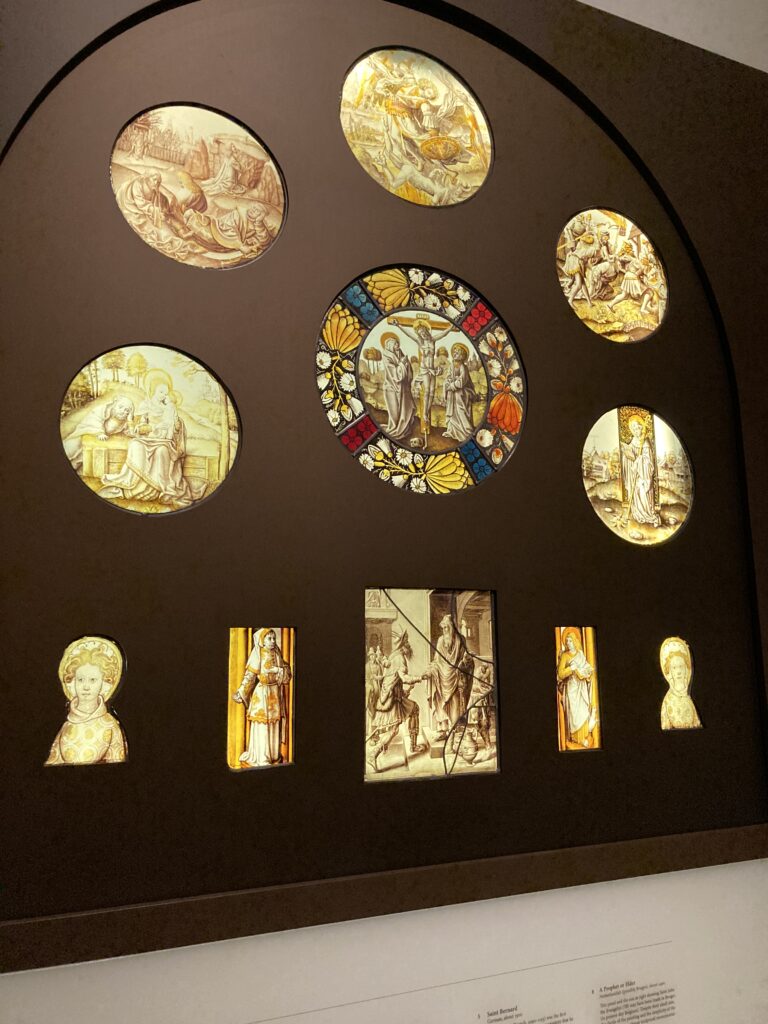
This a collection of roundels on display at the Getty. Dating to the early 1500s, each one is delicately illustrated with astonishing craftsmanship.
The center roundel in the Getty’s display is an image of the crucifixion. The image on the left is as it appears in the museum, illuminated from behind.
To see it without backlighting would be a far less inspiring experience, and I imagine it would be similar to the image on the right, shared from the Getty’s website (an image of the reverse side to show it in its pre-conservation state). Still beautiful, but far less alive than the fully lit window.
Did the Pre-Raphaelites Take a Cue From Stained Glass and Manuscripts of the Past?
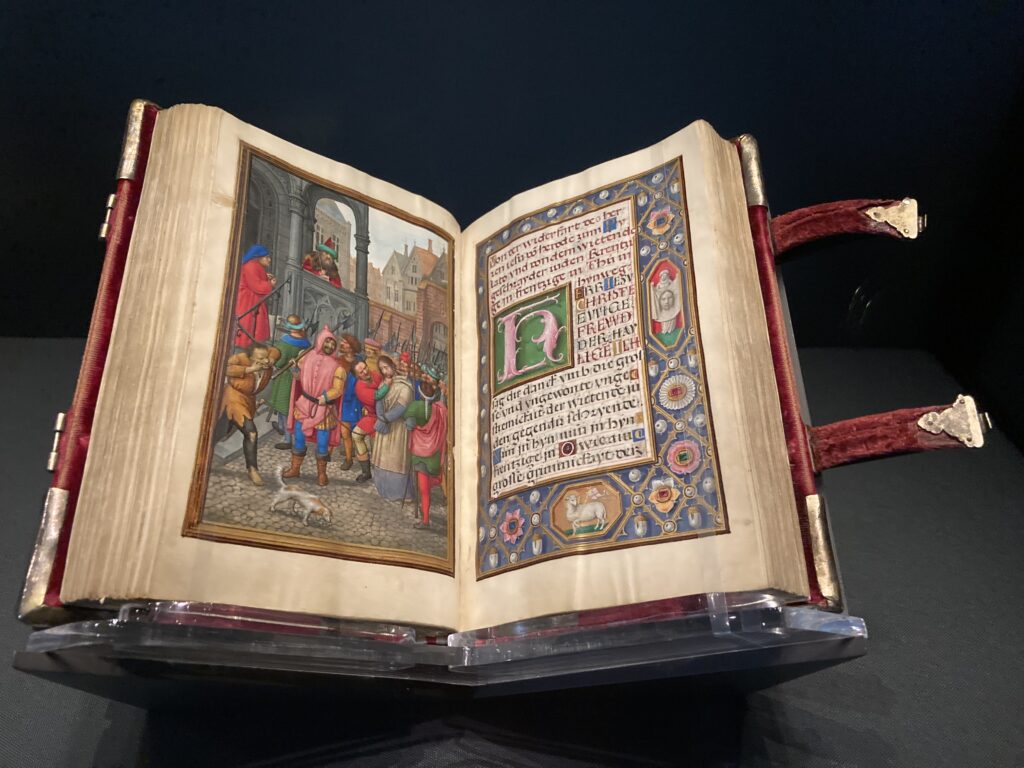
Fascinated by medieval and renaissance art, the Pre-Raphaelites were quite familiar with early Christian art, especially illuminated manuscripts and stained glass. They were enchanted by the distinctive style of that era, which may be one reason why so much of the PRB’s early works were religious in nature.
Illuminated manuscript from the 13th century, photographed during one of my visits to the Getty.
In contrast to the muddy brown art of the early to mid-nineteenth century, I believe the Pre-Raphaelites channeled the principle of stained glass into their creations, using their wet white ground as a sort of pseudo-illumination.
The luminous quality of a Pre-Raphaelite painting is not simply due to the prismatic colors the artists used. Like stained glass, it’s all about the light source, and though theirs is artificial, it works…stunningly so.
Ferdinand Lured by Ariel by Sir John Everett Millais
Appreciating Victorian art with my twenty-first century eyes, I can completely understand why critics had such a reflexively adverse reaction to the astonishing harmony of color and light the Pre-Raphaelites brought to the scene.
Change is often uncomfortable to absorb. The PRB and their associates ushered in a new period of art, almost as suddenly as Dorothy opening her sepia-colored door onto the technicolor world of Oz.
Pre-Raphaelite art is a bit like a successful recipe, with each essential ingredient contributing to the piece de resistance. The subject matter, the symbolism, and the detailed precision are all important elements. Subtract the incandescent sense of light and color, and the Pre-Raphaelites’ work would have lost the essence of its unique flavor.
In their ingenious pursuit of truth and how to express it, the Brotherhood revived art with an emotional intensity, energy and sense of wonder that still inspires.
The Pre-Raphaelites created art that is known for its vivd and colorful brilliance, achieved by painting white backgrounds that they would later paint over in thin layers of oil paint. Their work was meticulous and their subject matter drew inspiration from myths, legends, Shakespeare, Keats, and lovely long haired damsels that we now equate with Victorian beauty.
Frequently Asked Questions
While it can seem to be an umbrella term, it actually refers to
Art created by members of the Pre-Raphaelite Brotherhood and their followers.
2. The literature that grew out of the Pre-Raphaelite art movement.
The Pre-Raphaelites wanted to return to the detailed, vibrant, and sincere art that existed before the time of the Renaissance painter Raphael (hence Pre-Raphaelite). They believed that after Raphael, European art had become too mechanical and formulaic.
The Pre-Raphaelite Brotherhood began in 1848 as a secret society of young artists:
Dante Gabriel Rossetti
William Michael Rossetti
Thomas Woolner
William Holman Hunt
Frederic George Stephens
James Collinson
John Everett Millais.
The members of the Pre-Raphaelite Brotherhood were rebelling against the current art establishment, mainly the British Royal Academy, and its formulaic approach to art instruction. Though the Pre-Raphaelites’ goal was to remain secret, the meaning of the initials “PRB” inscribed on their paintings became public (possibly leaked by Dante Gabriel Rossetti).
In character and temperament, the members of the Brotherhood were vastly different. Millais, Rossetti, and Holman Hunt each had his own distinctive style, but one thing they all agreed on was their displeasure with the way artists were instructed at the Royal Academy. Training there was formulaic and dry, which led to generations of British art that the Pre-Raphaelites saw as dark and unimaginative. They longed to rebel against the first president of the RA, Sir Joshua Reynolds (they referred to him as Sir Sloshua).
These bright and talented idealists were radical for the time and their goals were sincere. They wanted to rejuvenate the art world, to remind the Royal Academy that paintings could be dazzling and colorful while still maintaining the dignity of accuracy.
The brotherhood believed that for the art world to be revived, it needed to return to the time before the 16th century painter Raphael, and thus, the name Pre-Raphaelite was born. In the midst of the Industrial Revolution and scientific discovery, these artists looked backward and created works that celebrated a distinctly Medieval aesthetic, yet with a realism that stunned the viewer.
The Brotherhood’s early doctrines were expressed in four declarations:
To have genuine ideas to express;
To study Nature attentively, so as to know how to express them;
To sympathize with what is direct and serious and heartfelt in previous art, to the exclusion of what is conventional and self-parodying and learned by rote;
And, most indispensable of all, to produce thoroughly good pictures and statues.
Inspired by late Medieval and early Renaissance works, the Pre-Raphaelites created paintings that were vibrantly different than the art of their contemporaries. Their efforts to stay true to nature resulted in botanical details that were painstakingly reproduced and the doctrines they adhered to resulted in paintings with an almost photographic realism. They had their critics, however, and their work was not easily accepted. (Charles Dickens was a vocal critic. Later, though, he became good friends with Millais.)
Though they were a brotherhood, there were many women in their circle that were crucial to the growth of Pre-Raphaelite art. These are the women that inspired the creation of this website. A diverse group of models, wives, family, friends, and lovers, the movement we now know as Pre-Raphaelitism is threaded with the repeated and vast contributions from these women. Several were artists themselves and most of them have familiar faces; they grace the canvasses painted by many of the brotherhood and their followers.
The Brotherhood itself did not last very long. The artists grew in different directions and their styles changed. For the most part, they stayed true to the principles that guided them in 1848, albeit in their own individual ways. The members of the Pre-Raphaelite Brotherhood and the artists they influenced had a profound effect on 19th and early 20th-century art. In fact, once you are familiar with them, you can easily spot their influence in popular culture today.
Classical mythology, Shakespearean scenes, Biblical stories, and modern themes such as the plight of fallen women, were all of interest to the Pre-Raphaelites.
The brotherhood and many of their associates were captivated by literature and wanted to create work that incorporated poetic and literary themes, as well as addressing social injustice. Their works reflected meaningful narratives, but their genius was that it didn’t merely tell a story, but often posed questions that left the viewer wondering.